
Our Story

Four generations, one business, and a love for bees that has survived even war.
My beekeeping story is the story of my family, which has been passed down from generation to generation for over a hundred years. I am a fourth-generation beekeeper — and it’s possible our beekeeping heritage extends even further back. For us, bees are not just a hobby or a business. They are a family tradition, our livelihood, our expression of love for nature, and our way of honoring the memory of our ancestors.
It all started with my great-grandfather Savva. He was the headman of our village, then called Alekseevka, in eastern Ukraine, and he kept three beehives. In 1943, he was called up to fight against the German occupiers. He died heroically near Leningrad, leaving behind his wife Christina and two sons, Victor and Ivan. Before her husband left Christina promised him that, no matter what, she would take care of the bees. And she kept her word. In those difficult years during and after World War II, bees were especially valuable to the family. They used their wax to make candles, and honey was almost the only treat for the children. Despite all the hardships of wartime Christina preserved the apiary—and with it the family tradition begun by her husband.
Christina’s children grew up curious and active. They loved watching the bees and their tireless work. Later, the eldest son, Victor, began to help his mother in the apiary. Over the years his hobby grew into a small business and his apiary grew to 50 bee colonies. Victor had three children, and his son Anatolii was interested in bees from childhood. After learning from his father and starting his own small apiary he was offered a job at a collective apiary. There he gained experience in professional, commercial beekeeping, and learned how to turn a family hobby into a full-fledged business. He soon founded his own commercial apiary of 100 bee colonies.
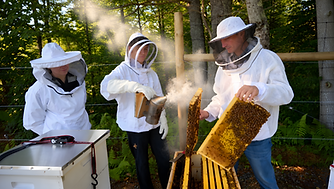
His son, also named Anatolii, is me. I also grew up among bees. From childhood I helped my father: I worked in the apiary, studied the lives of the bees, and helped in harvesting honey. Over the years I came to understand that beekeeping was not just a family tradition but a business to which I wanted to devote my life. In 2010, I started my own commercial apiary. I worked hard to innovate and develop the apiary and gradually increased the number of colonies. By 2022, my apiary had 250 colonies.
But that year our lives changed dramatically. Russian aggression brought war and occupation to our land. It became dangerous to stay at home and my wife Iryna, my son Stanislav, and I had to leave our native land. Stanislav, like all previous generations of our family, is also interested in bees. I have always wanted to pass on this family passion to him, so that he would know our history and understand the value of what our ancestors worked so hard to preserve.
Leaving our beloved home, our normal life, and our apiary, into which we had invested so many years of work, was painful. Along with the hives, we left a part of our history and a part of our hearts. However, we did not lose the most important things: our knowledge and experience, our love for bees, and our desire to continue the family business. When we left Ukraine, I made a promise to my mother, Lidia: that whatever happened I would continue beekeeping.
And so fate has brought our family to a wonderful place in America—the Upper Valley. Here we have been given the opportunity to start a new chapter in our lives, and there is no question how we must show our gratitude: by continuing our beekeeping, creating an apiary, and sharing the results of our labor with the local community.
That began last April, when I volunteered my time to establish an apiary for Willing Hands, which grows and gathers food and delivers it at no charge to organizations that serve some 30,000 individuals in need. I named it Lidia’s Apiary, after my mother, who remains in Ukraine. You can find this apiary at the northeast corner of the Willing Hands orchard on Church Street in Norwich.
The Upper Valley community had taken us in after we’d fled a war and were in greet need, providing us with a new start. Volunteering my skills to a charitable organization that serves that community was a first way of expressing my family’s gratitude, which is immeasurable.
This was only the start. Soon after, I created an apiary on private land in Northern Norwich. In 2027, Upper Valley Apiaries expects to be operating at least six apiaries throughout the Upper Valley.
For me, this is much more than just reviving the business. It is a continuation of the story that began with my great-grandfather Savva’s three beehives. It is the memory of Christina, who kept her promise and saved the bees in the most difficult times. It is the work of Victor and two generations of beekeepers named Anatolii, who developed the apiary and added immeasurably to the family’s knowledge. And it is the fulfillment of another family promise, the one I made to my mother, Lidia, for whom we have named our honey.
Today we begin again, on American soil. I hope that our bees will continue to provide people with natural honey, and our family tradition will live on for many generations to come. After all, for us, beekeeping is not just about honey. It is our history, our heritage, and our love, which does not disappear even when we must start all over again.


For us, beekeeping is not just about honey. It is our history, our heritage, and our love, which carries on across generations of care and craftsmanship.